Last week, the U.S. Court of Appeals for the Federal Circuit issued a precedential opinion in Range of Motion Products, LLC v. Armaid Company Inc., No. 2023-2427 (Feb. 2, 2026), affirming summary judgment of noninfringement entered by the U.S. District Court for the District of Maine.
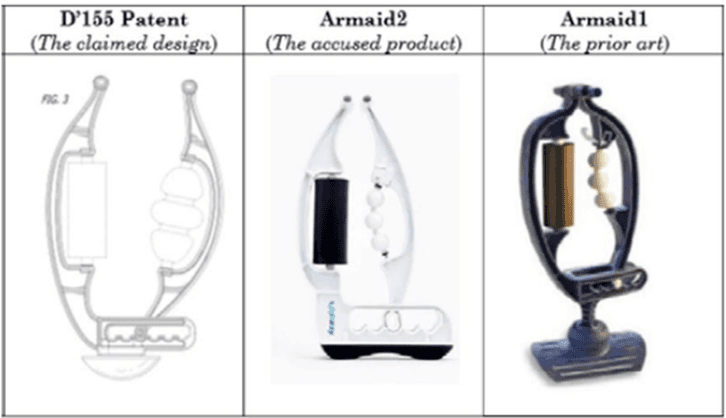
Range of Motion (“RoM”) sued Armaid alleging infringement of U.S. Design Patent No. D802,155, which claims “[t]he ornamental design for a body massaging apparatus”. RoM’s “Rolflex” device embodies the patented design, while Armaid's “Armaid2” was the accused product.
On appeal, RoM challenged the district court's claim construction, arguing that it improperly eliminated structural elements—specifically the clamshell shape of the arms—from the claimed design. The Federal Circuit disagreed, holding that the district court properly identified the clamshell shape of the arms as functional—enabling the device to open and close around a user’s limb for massage—while considering that “other features ‘appear to be largely ornamental,’ such as ‘the thick ridged outline’ of the design (which includes the arms).” The Court rejected RoM’s assertion that “all elements depicted by the solid lines [in the D’155 patent drawings] are ornamental, and all elements depicted by the dotted lines are functional.”
Regarding infringement, the Court applied the “ordinary observer” test—which asks whether an observer familiar with the prior art would find the claimed and accused designs “substantially the same”—and found that the district court’s analysis properly focused on the designs’ overall ornamental appearance and whether the nonfunctional, ornamental aspects of the two designs were “plainly dissimilar.” The Court noted that key differences between the D’155 patent and Armaid2 include: (1) the hinge apparatus of the Armaid2 that makes up proportionally more of the device and forms the entire base of the product; (2) the Armaid2’s “overall segmented appearance,” unlike the D’155 patent; (3) the Armaid2’s larger size-selection slots; and (4) the blunter, less rounded end of the hinge apparatus in the Armaid2. The Court criticized RoM’s approach of “focusing primarily on the shapes of the arms” for “failing to ensure that functional aspects of the design do not play a role in the infringement analysis.”
Chief Judge Moore dissented, stating that a reasonable jury could find the designs substantially similar, and criticizing the Court's “plainly dissimilar/sufficiently distinct” framework as improperly shifting the focus of the infringement analysis from similarities to differences between the claimed and accused designs.